


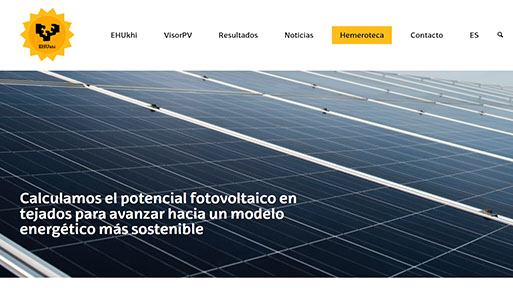
Irudi EU has developed the new website for EHUkhi, a project sponsored by Campus Bizia Lab and the University of the Basque Country / Euskal Herriko Unibertsitatea (UPV/EHU), and developed by the research groups Ekopol and Enedi.
The new web page, available in two languages, was created with a clear objective: to explain in an accessible way the work of a multidisciplinary university team that combines engineering, physics, technology, sustainability and territorial analysis to answer an increasingly relevant question: how much solar energy could be generated by taking advantage of existing rooftops?
A Website to Make Research Visible
EHUkhi is a university initiative that connects different areas of knowledge to advance the analysis of the photovoltaic potential of buildings, campuses and municipalities. Its work focuses on studying how already-built roofs can be leveraged to produce solar energy, reducing the need to occupy new land and bringing the energy transition closer to the urban environment.
The project uses a methodology based on geographic data, energy calculation and open-source software. Using information such as roof orientation, inclination, shadows, temperature and actually available surface area, EHUkhi allows estimation of how much electricity could be produced through solar panels installed on rooftops.
The new website organizes and presents this knowledge clearly, in an accessible manner, and oriented to both public institutions and people interested in solar energy, self-consumption and urban sustainability.
Solar Energy, City and Sustainability
EHUkhi's work starts from a key idea: cities concentrate a large part of energy consumption and emissions, but they also have already-built surfaces that can be used to generate renewable energy.
In applied studies such as that of Vitoria-Gasteiz, the EHUkhi methodology has made it possible to estimate the potential of rooftops to produce electricity through photovoltaic panels. The published results show particularly relevant figures: a significant portion of urban rooftops could be suitable for solar installations and contribute significantly to the city's electrical consumption.
This approach makes EHUkhi a tool of interest for municipalities, public entities, energy communities and agents linked to local energy planning.
A University Project with Social Vocation
EHUkhi is part of a line of work linked to sustainability, energy transition and knowledge transfer from the university to society.
The project is sponsored by Campus Bizia Lab and UPV/EHU, and features the participation of research groups such as Ekopol and Enedi, which provide expertise in areas such as energy, ecological economics, engineering, sustainability and territorial analysis.
The website developed by Irudi EU seeks to reflect that collaborative dimension: a scientific initiative, but also pedagogical and social, aimed at facilitating new ways of understanding the role of solar energy in urban environments.
Digital Communication for Projects with Impact
From Irudi EU, the development of this website involved working on a clear, bilingual digital structure prepared to grow with new content, results, news and dissemination resources.
The objective was not only to create an informative page, but to build a communication tool capable of accompanying the project's evolution, giving visibility to the research team and facilitating the knowledge generated to reach further.
EHUkhi demonstrates that university research can become a real lever for imagining more sustainable cities. And that, when data is explained well, rooftops stop being just rooftops: they can become maps of the future.


